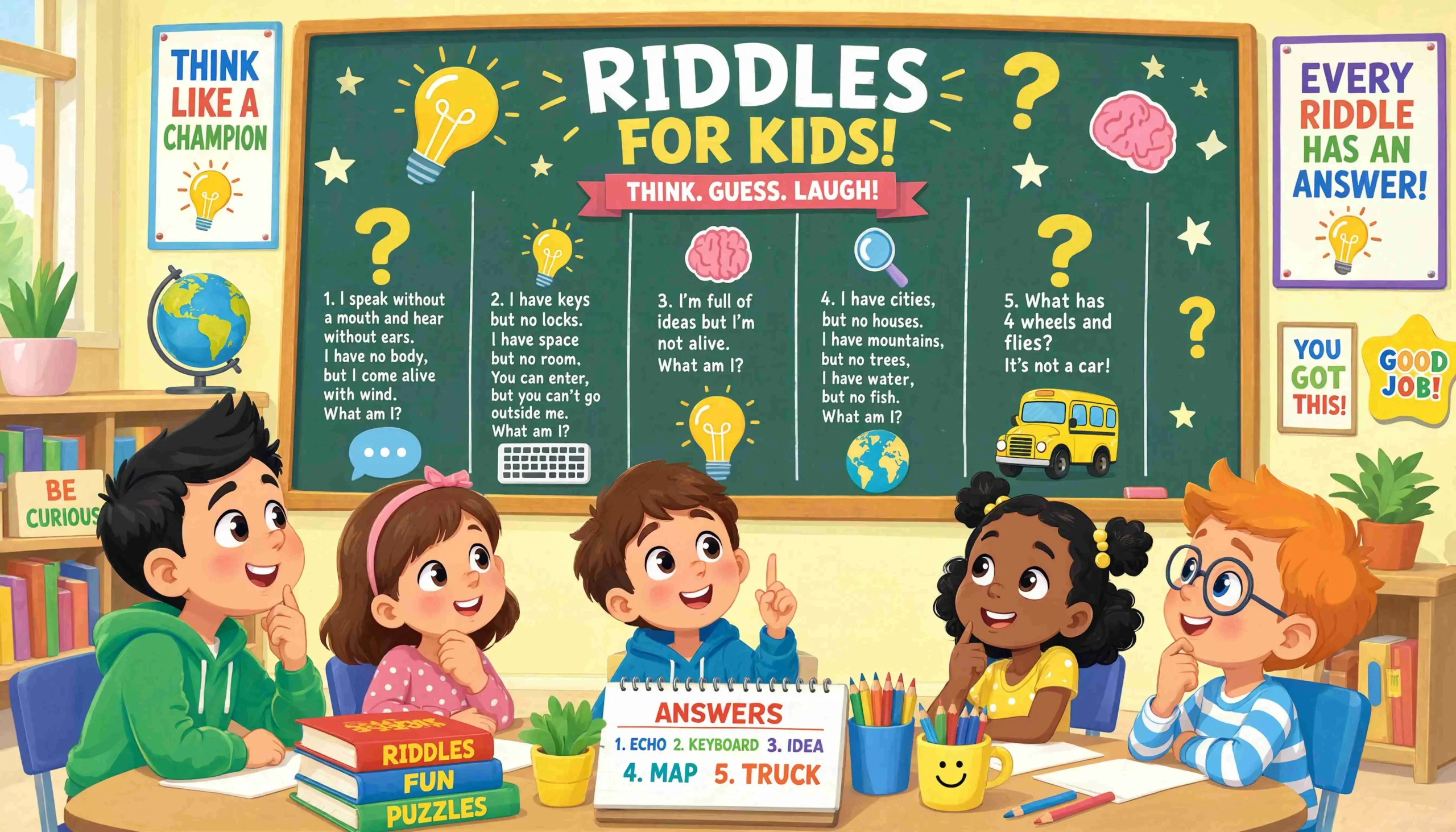
Ready to put your thinking cap on and have some fun? These riddles for kids with answers are packed with laughter, creativity, and brain-boosting challenges that will keep young minds entertained for hours. Some are easy, some are tricky, and a few might surprise even the smartest puzzle solvers!
Riddles are more than just fun games—they help children develop critical-thinking skills, improve vocabulary, strengthen problem-solving abilities, and encourage creative thinking. Whether you’re a parent looking for family fun, a teacher planning classroom activities, or a kid who loves a good challenge, these riddles offer the perfect mix of learning and entertainment.
In this collection of 77+ Riddles for Kids and Answers, you’ll find funny, clever, and age-appropriate brain teasers for every occasion. Read each riddle carefully, make your best guess, and see how many you can solve before peeking at the answer. Let’s get started and put your puzzle-solving skills to the test!
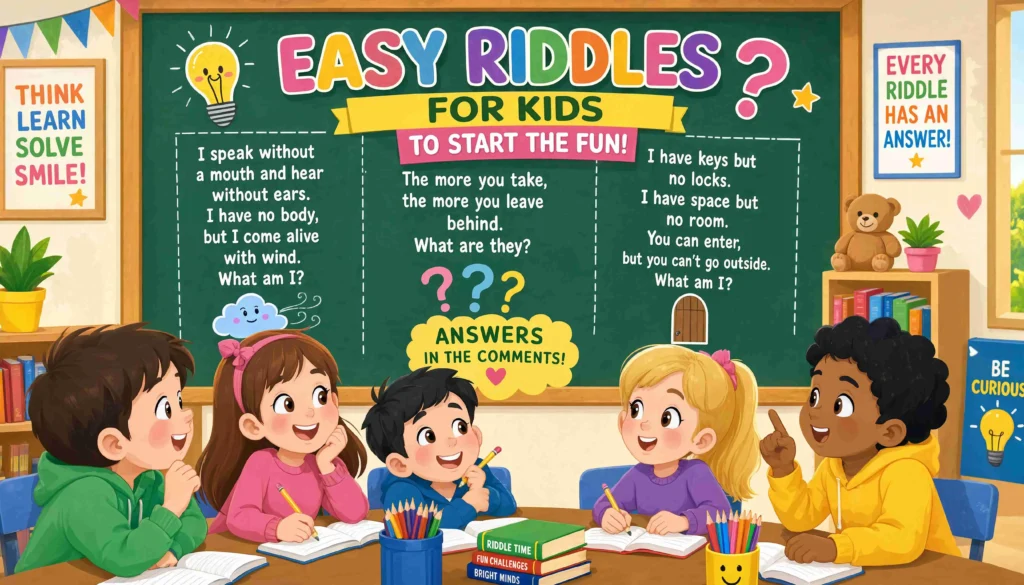
Easy Riddles for Kids to Start the Fun
- 🌙 What has hands but cannot clap? Answer: A clock
- 🎉 What goes up but never comes down? Answer: Your age
- ✨ What gets wetter as it dries? Answer: A towel
- 🌙 What has one eye but cannot see? Answer: A needle
- 🎉 What has many keys but cannot open doors? Answer: A piano
- ✨ What has four legs but cannot walk? Answer: A table
- 🌙 What can you catch but not throw? Answer: A cold
- 🎉 What is full of holes but still holds water? Answer: A sponge
- ✨ What has a neck but no head? Answer: A bottle
- 🌙 What can run but never walk? Answer: Water
Funny Riddles for Kids That Bring Big Laughs
- 🎉 Why did the teddy bear skip dessert? Answer: It was stuffed
- ✨ What kind of tree fits in your hand? Answer: A palm tree
- 🌙 Why was the math book sad? Answer: It had too many problems
- 🎉 What building has the most stories? Answer: A library
- ✨ What kind of room has no doors? Answer: A mushroom
- 🌙 What do you call a sleeping bull? Answer: A bulldozer
- 🎉 Why did the cookie go to the doctor? Answer: It felt crumbly
- ✨ What has ears but cannot hear? Answer: A cornfield
- 🌙 Why did the banana go to school? Answer: To get smarter
- 🎉 What kind of fish practices medicine? Answer: A sturgeon
Animal Riddles Kids Will Love Solving
- ✨ What animal is called the king of the jungle? Answer: A lion
- 🌙 Which animal carries a pouch? Answer: A kangaroo
- 🎉 What black-and-white animal looks like a horse? Answer: A zebra
- ✨ Which bird cannot fly and lives in cold places? Answer: A penguin
- 🌙 What animal says moo? Answer: A cow
- 🎉 Which pet likes chasing mice? Answer: A cat
- ✨ What animal has a long trunk? Answer: An elephant
- 🌙 Which insect makes honey? Answer: A bee
- 🎉 What animal is famous for humps? Answer: A camel
- ✨ Which animal carries its home on its back? Answer: A turtle
Clever Brain Teasers for Curious Young Minds
- 🌙 The more you take away, the bigger I get. What am I? Answer: A hole
- 🎉 What has a head and a tail but no body? Answer: A coin
- ✨ What belongs to you but others use it more? Answer: Your name
- 🌙 What can travel around the world while staying in one corner? Answer: A stamp
- 🎉 What can be broken without touching it? Answer: A promise
- ✨ What has words but never speaks? Answer: A book
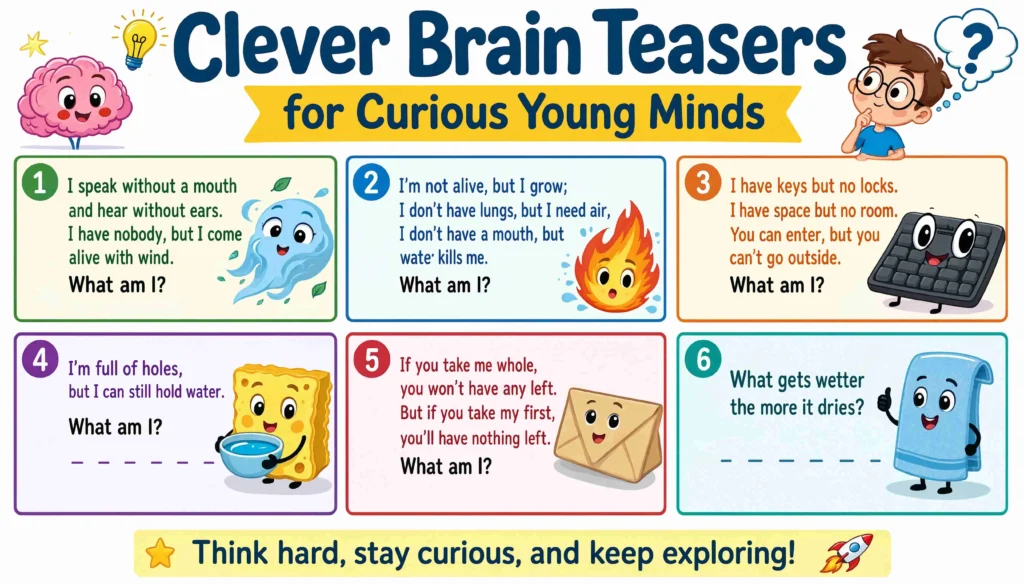
- 🌙 What begins with T and ends with T and has tea inside? Answer: A teapot
- 🎉 What comes once in a minute, twice in a moment, and never in a thousand years? Answer: The letter M
- ✨ What gets bigger the more you fill it? Answer: A balloon
- 🌙 What can you hold without touching? Answer: Your breath
Educational Riddles That Make Learning Fun
- 🎉 Which planet do we live on? Answer: Earth
- ✨ How many days are in a week? Answer: Seven
- 🌙 What color do blue and yellow make? Answer: Green
- 🎉 What is 5 plus 5? Answer: Ten
- ✨ Which star lights up our day? Answer: The Sun
- 🌙 How many legs does a spider have? Answer: Eight
- 🎉 What shape has three sides? Answer: A triangle
- ✨ What do bees make? Answer: Honey
- 🌙 What do plants need to grow? Answer: Water
- 🎉 What do we use to tell time? Answer: A clock
Everyday Life Riddles Kids Can Relate To
- ✨ What do you wear on your feet? Answer: Shoes
- 🌙 What keeps food cold? Answer: A refrigerator
- 🎉 What do you use to brush your teeth? Answer: A toothbrush
- ✨ What keeps you dry in the rain? Answer: An umbrella
- 🌙 What do you sleep on? Answer: A bed
- 🎉 What do you sit on? Answer: A chair
- ✨ What helps you write? Answer: A pencil
- 🌙 What carries books to school? Answer: A backpack
- 🎉 What opens a locked door? Answer: A key
- ✨ What helps you see in the dark? Answer: A flashlight
Word Riddles to Build Vocabulary Skills
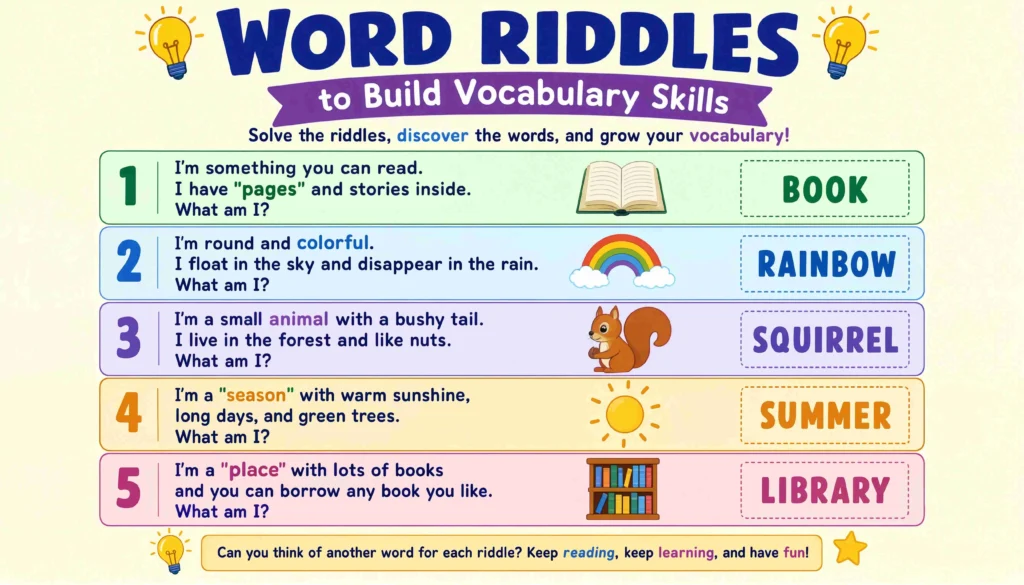
- 🌙 What word means the opposite of hot? Answer: Cold
- 🎉 What word rhymes with cat? Answer: Hat
- ✨ What word means a baby cat? Answer: Kitten
- 🌙 What word means happy? Answer: Glad
- 🎉 What word means a place to learn? Answer: School
- ✨ What word means a large body of water? Answer: Ocean
- 🌙 What word means a house for books? Answer: Library
- 🎉 What word means a young dog? Answer: Puppy
- ✨ What letter comes after A? Answer: B
- 🌙 What letter comes before C? Answer: B
General Knowledge Riddles for Smart Kids
- 🎉 What is the largest ocean on Earth? Answer: Pacific Ocean
- ✨ Which season comes after summer? Answer: Autumn
- 🌙 How many months are in a year? Answer: Twelve
- 🎉 Which planet is known as the Red Planet? Answer: Mars
- ✨ What do caterpillars become? Answer: Butterflies
- 🌙 What is frozen water called? Answer: Ice
- 🎉 What is the capital of France? Answer: Paris
- ✨ What do baby frogs become? Answer: Frogs
- 🌙 What is the tallest animal? Answer: A giraffe
- 🎉 Which continent is the largest? Answer: Asia
FAQs
What are 20 riddles?
Twenty riddles are simply a collection of twenty fun questions that challenge children to think and solve puzzles.
What are the 10 examples of riddles with answers?
Examples include What gets wetter as it dries? A towel, and What has hands but cannot clap? A clock.
What are 100 good riddles?
Good riddles are simple, fun, age-appropriate, and encourage creative thinking and problem-solving.
What is the easiest riddle?
What goes up but never comes down? Your age.
Are riddles good for kids?
Yes. Riddles help improve memory, vocabulary, logic, creativity, and critical thinking skills.
Conclusion
Riddles are a simple and enjoyable way to help children learn while having fun. They encourage creativity, improve vocabulary, strengthen problem-solving skills, and build confidence. From funny questions and animal puzzles to brain teasers and educational challenges, these activities keep young minds active and engaged.
We hope these riddles for kids and answers bring plenty of smiles, laughter, and learning moments. Share them with friends, family members, classmates, and teachers to make every day more exciting. The best riddles are the ones that inspire children to think, imagine, and discover new ideas while having fun along the way.

Stella Gibbons was an English novelist and poet, best known for Cold Comfort Farm, a witty satire that humorously mocked rural melodrama and literary traditions.