Have you ever seen students suddenly become more alert and excited when you ask them a tricky question? Trick questions for students are amazing tools that turn ordinary learning into an adventure. These clever puzzles capture attention, spark curiosity, and make young minds work in creative ways. Teachers love using them because they make students think differently.
The beauty of these questions is that they work for every age group. Whether you are teaching first graders or high school seniors, trick questions break the monotony and get everyone involved. They are perfect for morning warm-ups, brain breaks between lessons, or fun Friday activities. Students who are usually quiet often come alive when trying to solve these puzzles.
In this article, you will discover a wonderful collection of trick questions designed especially for students. Each question comes with a simple answer that will make everyone smile and say oh that was clever. These puzzles are perfect for classrooms, study groups, and even family learning time. Get ready to challenge young minds and watch them grow smarter with every question.
Easy Trick Questions for Students to Start With
Every great puzzle begins with an easy challenge. These simple trick questions are perfect for young learners because they build confidence while encouraging careful thinking. Even though the questions look easy, many people answer too quickly and miss the hidden clue.
Take a deep breath, read each question slowly, and try to solve it before looking at the answer. Remember, the goal is not just to be right—it is to train your brain to think differently.
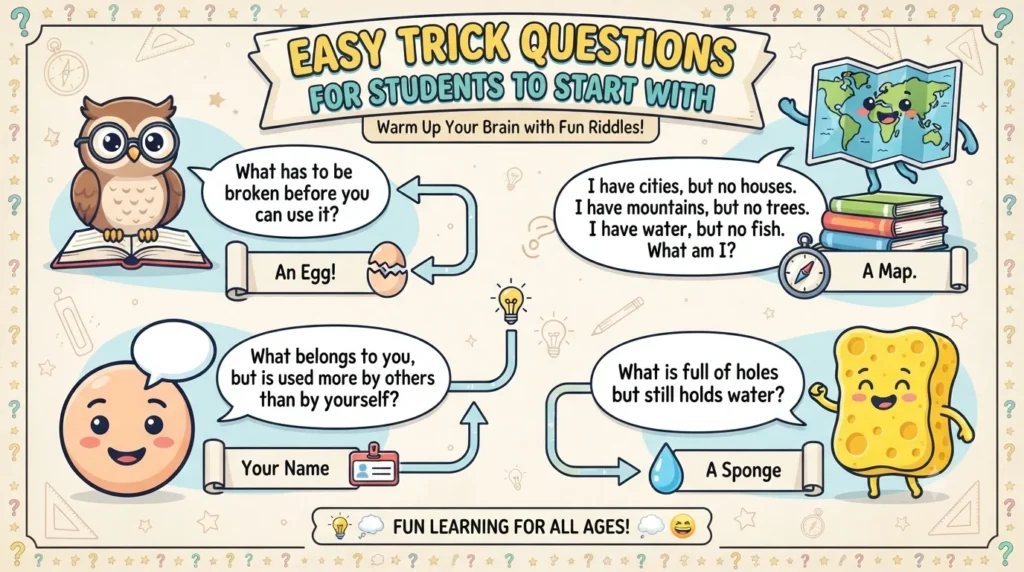
- 🎈 What has to be broken before you can use it?
Answer: An egg. You must crack the shell before you can cook or eat it. - 🌙 What goes up but never comes down?
Answer: Your age. Every birthday adds another year, and it never goes backward. - ✨ What has hands but cannot clap?
Answer: A clock. Its hands move around the clock face, but they cannot clap. - 🎉 What has a neck but no head?
Answer: A bottle. The neck is simply part of the bottle’s shape. - 🌟 What gets wetter the more it dries?
Answer: A towel. It dries other things while becoming wet itself. - 🍀 What can you catch but never throw?
Answer: A cold. You can catch a cold, but you cannot throw it away. - 🌈 What has a face and two hands but no arms or legs?
Answer: A clock. Its face shows the time, and its hands point to the hours and minutes. - 🚀 What has keys but cannot open locks?
Answer: A piano. Its keys make music instead of opening doors. - 🌸 What has a bottom at the top?
Answer: Your legs. Your bottom is above your legs. - 🍭 What has one eye but cannot see?
Answer: A needle. Its eye is the small hole where the thread goes.
Brain Boost Tip 💡
Easy riddles may seem simple, but they teach an important lesson. Before answering any question, slow down and read every word carefully. Good problem-solvers do not rush—they observe, think, and then answer with confidence.
Funny Trick Questions for Students That Make Everyone Laugh
Learning becomes much more exciting when everyone is laughing. Funny trick questions create a relaxed classroom environment and encourage students to participate without worrying about making mistakes. They are also perfect for family game nights, school competitions, and icebreaker activities.
These funny tricky questions with answers prove that learning and laughter can go hand in hand.
- 🐄 What do you call a cow with no legs?
Answer: Ground beef. It is a classic joke that surprises almost everyone. - 🐧 What do you call a penguin in the desert?
Answer: Lost. Penguins belong in cold places, not hot deserts. - 🍕 What do you call a fake noodle?
Answer: An impasta. It is a fun play on the word imposter. - 🐻 What do you call a bear with no teeth?
Answer: A gummy bear. Just like the popular candy. - 🦷 What do you call a dinosaur with a huge vocabulary?
Answer: A thesaurus. It sounds like dinosaur but means a book of synonyms. - 🍌 Why did the banana go to the doctor?
Answer: Because it was not peeling well. A silly joke that always gets a smile. - 🐔 Why did the chicken cross the playground?
Answer: To get to the other slide. A playful twist on the famous joke. - 🎵 What kind of music do mummies enjoy?
Answer: Wrap music. A funny wordplay on rap music. - 🐶 What do you call a sleeping bull?
Answer: A bulldozer. This clever joke makes everyone laugh. - 🍎 What do you call an apple that plays the guitar?
Answer: A jam session. Apples become jam, making this answer extra funny.
Why Funny Questions Help Students
Humor makes learning easier to remember. When students laugh, they feel more relaxed and confident, making it easier to understand new ideas and think creatively. That is why teachers often use funny riddles and brain teasers as classroom warm-up activities.
What Makes Trick Questions So Effective?
Many people think trick questions are only for entertainment, but they are actually powerful learning tools. They encourage students to slow down, read carefully, and question their first thoughts instead of answering too quickly.
This simple habit improves reading comprehension, observation skills, logical reasoning, and creative thinking. Over time, students become better problem-solvers because they learn to look beyond the obvious answer.Mind Trick Questions with Answers to Twist Your Brain
Sometimes the smartest answer is not the first one that comes to your mind. That is what makes mind trick questions with answers so exciting. These clever puzzles encourage students to slow down, pay attention to every word, and think from a different perspective.
Instead of testing what you already know, these questions test how well you observe, analyze, and solve problems. They are excellent for classroom brain breaks, family game nights, and educational games for kids because they turn learning into an enjoyable challenge.
Take your time with each question. The obvious answer is not always the correct one.
- 🧠 A doctor and a boy’s father are both in a car accident. The father dies, but the surgeon says, I cannot operate on him because he is my son. How is this possible?
Answer: The surgeon is the boy’s mother. The question reminds us not to make assumptions. - 🚫 What is always coming but never arrives?
Answer: Tomorrow. No matter how long you wait, tomorrow always stays one day ahead. - 🔇 What has words but never speaks?
Answer: A book. Books are full of words, but they never talk. - 🚪 What has a head and a tail but no body?
Answer: A coin. Every coin has a head side and a tail side. - 🏠 What room do ghosts avoid?
Answer: The living room. It is a fun play on the word living. - 🌊 What has a mouth but never eats?
Answer: A river. The mouth is where the river flows into another body of water. - 🦷 What has teeth but cannot bite?
Answer: A comb. Its teeth help untangle hair. - 🎨 What has a canvas but no paint?
Answer: A tent. Canvas is the strong fabric used to make many tents. - 🌳 What has roots that nobody sees and is taller than trees?
Answer: A mountain. Its roots are deep underground. - 🌬️ What can fill a room but takes up no space?
Answer: Light. It brightens every corner without taking up physical space.
Brain Boost Tip 💡
Mind trick questions teach an important habit—never rush to answer. Careful reading and patient thinking often lead to the correct solution much faster than guessing.
Brain Teasers for Students to Boost Critical Thinking
Brain teasers are one of the best ways to improve critical thinking. They encourage students to look beyond the obvious answer and use logic instead of guessing. Teachers often use these learning riddles to start lessons because they grab attention and make students excited to participate.
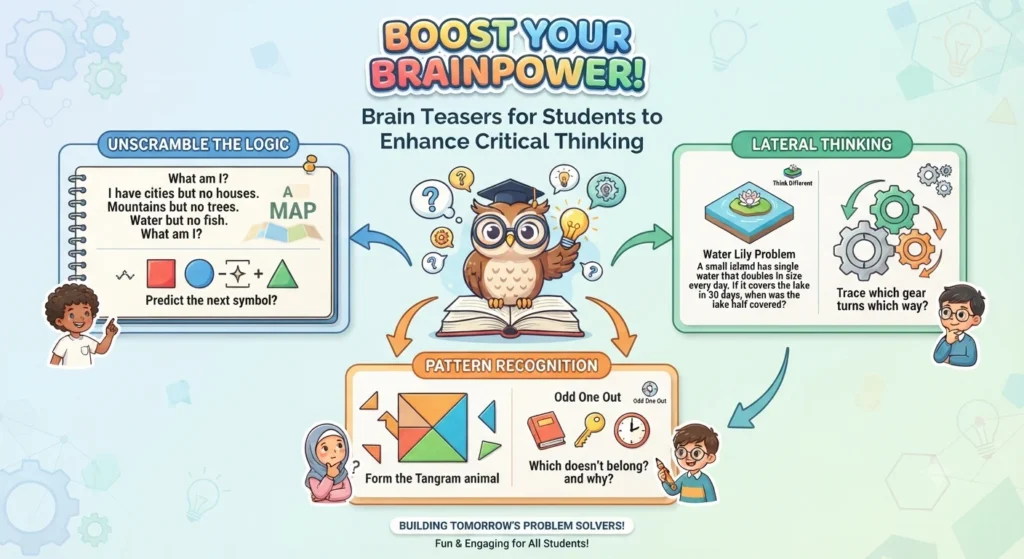
If a question feels difficult, do not worry. Every puzzle you solve makes your brain stronger and more creative.
- 🧩 A man is looking at a picture. He says, Brothers and sisters I have none, but that man’s father is my father’s son. Who is in the picture?
Answer: His son. Since he has no siblings, his father’s son is himself. - ⏳ What gets shorter as it grows?
Answer: A candle. As it burns, it becomes shorter. - 🔢 How many months have 28 days?
Answer: All twelve months. Every month has at least 28 days. - 🎯 What is so fragile that saying its name breaks it?
Answer: Silence. Speaking immediately ends it. - 🖐️ I have cities but no houses, mountains but no trees, and water but no fish. What am I?
Answer: A map. It shows places without being the real world. - 🔑 What has many keys but cannot open a single lock?
Answer: A keyboard. Its keys help you type instead of unlocking doors. - 🕳️ What is full of holes but still holds water?
Answer: A sponge. Its tiny holes help it absorb water. - 🎶 What has a bottom but no top?
Answer: Your legs. Your bottom is above them. - 📏 What must be measured but has no length?
Answer: Temperature. It is measured in degrees, not centimeters. - 🧊 What is bought by the yard but worn by the foot?
Answer: Carpet. It is sold by length but placed on the floor.
Why Brain Teasers Improve Learning
Brain teasers develop observation, logical thinking, memory, and creativity. They also teach students that making mistakes is part of learning. Every puzzle encourages children to think in new ways instead of relying on memorized answers.
Why Teachers Love Trick Questions
Teachers around the world use trick questions because they are quick, fun, and effective. A simple five-minute brain teaser can grab students’ attention before a lesson, improve classroom participation, and encourage even quiet learners to join the discussion.
These activities also help students:
- ✅ Improve reading comprehension.
- ✅ Build logical reasoning skills.
- ✅ Strengthen memory and concentration.
- ✅ Develop creative thinking.
- ✅ Learn through fun instead of pressure.
Because there is no complicated setup, trick questions work well in classrooms, homeschooling, tutoring sessions, and family learning activities.
Quick Challenge
Before moving to the next section, try creating your own trick question. Think about an everyday object, hide a clever clue inside the question, and ask a friend to solve it. Creating riddles is just as valuable as solving them because it improves creativity, vocabulary, and problem-solving skills.
Daily Life Trick Questions That Make You Think
The best trick questions do not always come from books. Many of them are based on everyday objects and situations that we see all the time but rarely think about. These daily life riddles help students become more observant and teach them to notice small details that are often overlooked.
Whether you are at home, in school, or spending time with friends, these puzzles will remind you that even ordinary things can become exciting brain challenges.
Read each question carefully before checking the answer. Sometimes the simplest object hides the trickiest clue.
- 🚗 What has four wheels and flies?
Answer: A garbage truck. Flies are often found around garbage, making this a clever word trick. - 🛏️ What goes from your bed to the floor but never moves?
Answer: Your feet. They are already there when you wake up. - 🚪 What can you open but never close?
Answer: Your eyes. Once you wake up and open them, they naturally blink but the trick is in the wording. - 🍽️ What can you break even if you never touch it?
Answer: A promise. Words alone can break it. - 💰 What can you keep after giving it to someone else?
Answer: Your word. Keeping your promise shows honesty and trust. - 🎁 What has a ribbon but is not a gift?
Answer: A typewriter. Older typewriters use an ink ribbon for printing. - 🏡 What has a garden but no flowers?
Answer: A kindergarten. The word garden is part of its name. - 🚿 What has a shower but no water?
Answer: A baby shower. It is a celebration, not a bathroom shower. - 🔔 What has a ring but no finger?
Answer: A telephone. It rings when someone calls. - 🖼️ What has a picture but no paint?
Answer: A photo frame. It holds a picture without painting it.
Everyday Learning Matters
Daily life trick questions help students connect learning with the world around them. Instead of memorizing facts, they encourage children to observe carefully, think logically, and discover that ordinary objects can hide surprising answers.
Word Trick Questions to Play with Language
Words can be playful, confusing, and full of hidden meanings. These word trick questions help students improve vocabulary, reading comprehension, and creative thinking while having fun.
Many of these puzzles depend on reading every word carefully instead of rushing to answer. That is why they are excellent classroom activities for building language skills.
- 🅰️ What word is spelled incorrectly in every dictionary?
Answer: Incorrectly. That is exactly how the word is spelled. - 🔁 What word becomes shorter when you add two letters to it?
Answer: Short. Adding er changes it to shorter. - 🔤 What has a head and a tail but no body?
Answer: A coin. It has two sides but no body. - 📖 What word is always pronounced wrong?
Answer: Wrong. It is another clever play on words. - 🎵 What has many letters but is not the alphabet?
Answer: A post office. It receives thousands of letters every day. - 🔀 What starts with T, ends with T, and has T inside?
Answer: A teapot. It begins and ends with the letter T and holds tea inside. - 🧩 What begins with E and contains only one letter?
Answer: An envelope. It can hold a single letter inside. - 📣 What comes once in a minute, twice in a moment, but never in one thousand years?
Answer: The letter M. - ✏️ What has words but cannot read?
Answer: A dictionary. It contains words but cannot read them. - 🌟 What question can you never answer with Yes?
Answer: Are you asleep? If you answer, you are awake.
Why Word Puzzles Are Important
Word puzzles improve vocabulary, reading accuracy, and communication skills. They also teach students to pay close attention to language, making them stronger readers and more confident writers.
Learning Tip for Students
The smartest students are not always the fastest. They are the ones who take time to read carefully, notice small clues, and think before answering.
Whenever you solve a trick question:
- 🧠 Read every word carefully.
- 🔍 Look for hidden clues.
- 💡 Think about different meanings.
- 😊 Do not be afraid to make mistakes.
- ⭐ Learn something new from every answer.
These simple habits will help you become a better learner both inside and outside the classroom.
Did You Know?
Research shows that solving riddles and brain teasers regularly can improve concentration, memory, and creative thinking. Even spending just 10 minutes a day on educational puzzles gives your brain a fun workout while helping you become a more confident problem-solver.
188+ Trick Questions That Make You Think and Challenge 4 you
Hard Trick Questions for Students to Challenge Smart Thinkers
If you solved the earlier riddles with ease, it is time for the ultimate challenge. These hard trick questions are designed for students who enjoy thinking outside the box. They may look confusing at first, but every puzzle has a logical answer waiting to be discovered.
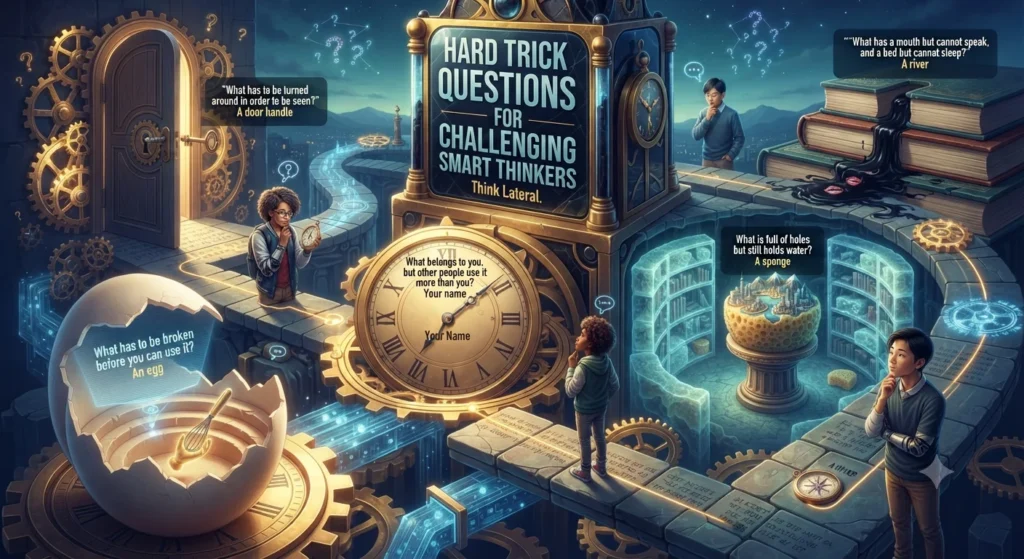
Do not worry if you cannot solve them all on your first try. The real goal is to strengthen your thinking skills, improve patience, and learn to look at problems from different angles. Read each question carefully, think before you answer, and enjoy the challenge.
- 🧠 A girl is sitting in a dark room with no lamp, no candle, and no flashlight, yet she is reading a book. How is this possible?
Answer: She is reading a Braille book. She does not need light to read it. - 🔢 What number is always in a hurry?
Answer: Number three because it is almost there. It is a fun play on words. - ❓ What is at the beginning of eternity, the end of time and space, and the beginning of every end?
Answer: The letter E. - 🎭 What can you see in the middle of March and April but not at the beginning or end of either month?
Answer: The letter R. - 🤫 If you have me, you want to share me. If you share me, you no longer have me. What am I?
Answer: A secret. - ⌨️ What has keys, space, and Enter but cannot open a single door?
Answer: A computer keyboard. - 🔄 What can run but never walks, has a bed but never sleeps, and has a mouth but never talks?
Answer: A river. - 🕰️ What has a face and hands but no arms or legs?
Answer: A clock. - 🏃 What runs around a yard without moving?
Answer: A fence. - 🎯 What can hit a target without having hands or feet?
Answer: An arrow.
Why Difficult Riddles Matter
Hard riddles teach students to think more deeply instead of searching for quick answers. They improve patience, reasoning, and confidence while showing that every problem can be solved with careful thinking. Even if you miss a few answers, every puzzle helps your brain grow stronger.
Why Trick Questions Help Students Learn Better
Trick questions are much more than a fun classroom activity. They encourage students to pause, observe, and think carefully before answering. This simple habit strengthens important life skills that are useful in school and beyond.
Students who regularly solve riddles and brain teasers can develop:
- ⭐ Better critical thinking skills
- ⭐ Stronger observation and attention to detail
- ⭐ Improved reading comprehension
- ⭐ More confidence when solving problems
- ⭐ Better creativity and communication skills
- ⭐ A positive attitude toward learning
Teachers and parents also enjoy using trick questions because they make learning interactive instead of stressful. A short brain teaser can quickly grab attention, start meaningful discussions, and create a classroom where students feel excited to participate.
FAQs
1. What are trick questions for students?
Trick questions are clever puzzles that have surprising or unexpected answers. They encourage students to read carefully, think logically, and avoid making quick assumptions. They are a fun way to improve problem-solving skills while making learning enjoyable.
2. Are trick questions good for classroom activities?
Yes. Teachers often use trick questions as warm-up exercises, brain breaks, quiz games, and group discussions. They help students stay focused, encourage teamwork, and make lessons more interactive without adding extra pressure.
3. Can younger children solve these riddles?
Absolutely. Many of the easy and funny questions are suitable for younger children, while the harder puzzles are better for older students. Parents and teachers can choose questions based on the child’s age and learning level.
4. How do brain teasers improve learning?
Brain teasers strengthen memory, observation, logical reasoning, and creative thinking. They also encourage students to slow down, read carefully, and look for hidden clues before answering.
5. How often should students practice trick questions?
Even spending 10 to 15 minutes a few times each week can make a difference. Regular practice helps students become more confident thinkers while keeping learning fun and engaging.
Conclusion
Learning becomes more exciting when curiosity leads the way. These trick questions for students are not just entertaining puzzles—they are valuable tools for building critical thinking, creativity, observation, and problem-solving skills. From easy warm-up riddles to challenging brain teasers, every question encourages students to slow down, think carefully, and enjoy the process of learning.
Whether you are a teacher planning engaging classroom activities, a parent looking for educational games for kids, or a student who loves a good challenge, this collection offers something for everyone. Share these riddles with your classmates, friends, or family and see who can solve the most without looking at the answers. Every puzzle is another opportunity to learn, laugh, and grow a little smarter.

Arnold Bennett was an English novelist and essayist, known for vivid realism and stories of the Potteries, capturing everyday life, ambition, and society in early 1900s!